Autophagy Zone
36-72h into your fast
Autophagy, your body's cellular recycling programme, is believed to increase significantly during this extended fasting phase. While most evidence historically came from animal studies, emerging human research (including 2025 trials measuring autophagy markers directly) is beginning to confirm these effects in people. This remains a fascinating area of active scientific investigation.
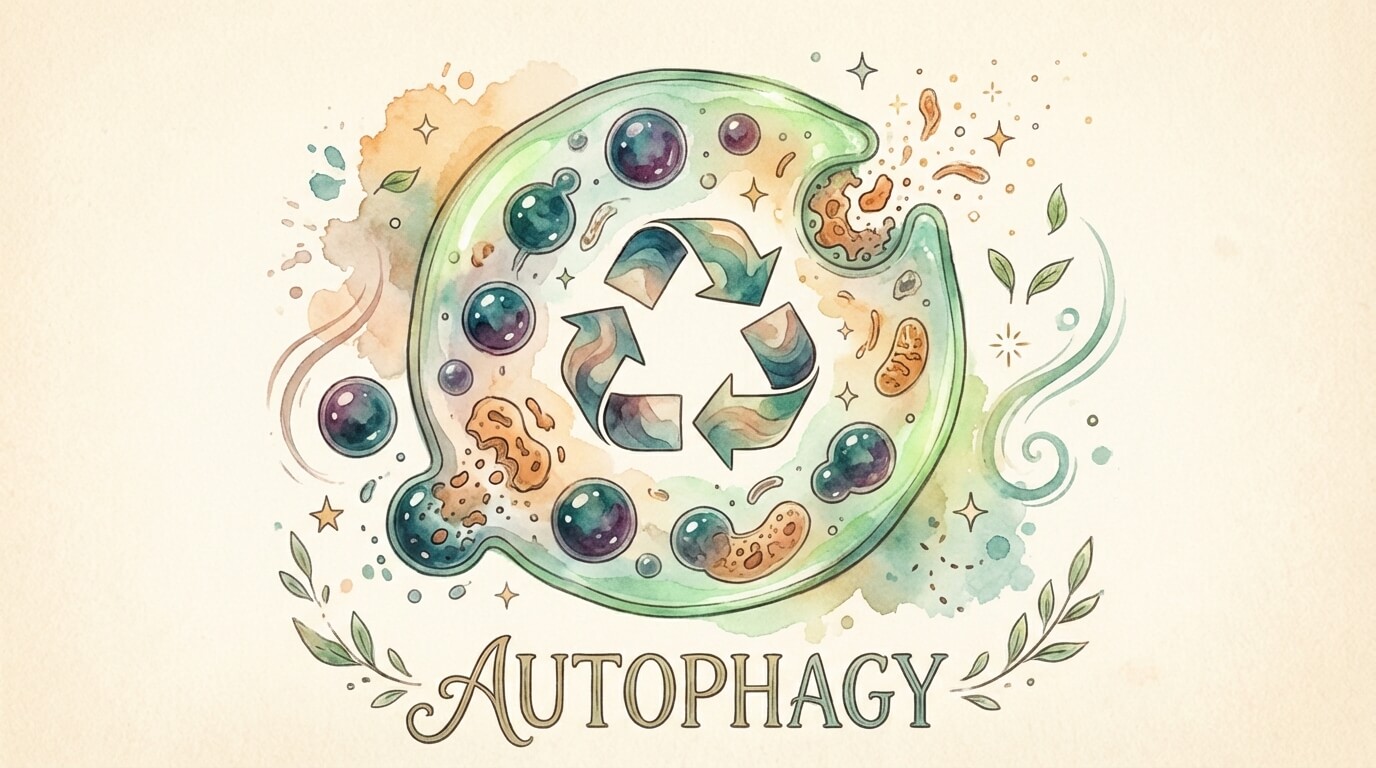
Key Processes During the Autophagy Zone
What Is Autophagy?
Autophagy (from Greek: "auto" meaning self, "phagy" meaning eating) is a fundamental cellular process responsible for the degradation and recycling of intracellular components. It's essentially your body's quality control system for cells.
During autophagy, cells identify, dismantle, and recycle:
- Damaged proteins: Misfolded or aggregated proteins that could be harmful
- Dysfunctional mitochondria: Energy-producing organelles that aren't working properly
- Worn-out organelles: Cellular components that need replacement
- Invading pathogens: Bacteria and viruses that enter cells
The 2016 Nobel Prize in Physiology or Medicine was awarded to Yoshinori Ohsumi for his discoveries of the mechanisms underlying autophagy, highlighting the importance of this cellular process.
How Autophagy Works: Lysosomes and Autophagosomes
The autophagy process involves specialised cellular structures working together:
1. Recognition: The cell identifies material for degradation-damaged proteins, dysfunctional organelles, or cellular debris. This material gets tagged with a protein called ubiquitin, marking it for disposal.
2. Engulfment: A double-membrane structure called an autophagosome forms around the tagged material, essentially wrapping it up for delivery.
3. Degradation: The autophagosome fuses with a lysosome-a cellular compartment containing digestive enzymes. Think of lysosomes as the cell's recycling centre, filled with enzymes that can break down virtually any biological material.
4. Recycling: The broken-down components (amino acids, fatty acids, etc.) are released back into the cell to be used as building blocks for new proteins and organelles or as fuel for energy production.
The AMPK and mTOR Pathways
Autophagy is primarily regulated by two opposing nutrient-sensing pathways: AMPK and mTOR.
mTOR (mechanistic Target of Rapamycin) is like a cellular growth switch. When nutrients are abundant:
- mTOR is activated
- The cell focuses on growth and protein synthesis
- Autophagy is suppressed
AMPK (AMP-activated protein kinase) is an energy sensor. When energy is low (like during fasting):
- AMPK is activated
- AMPK inhibits mTOR
- This releases the brakes on autophagy
During intermittent fasting, nutrient-sensing pathways respond to reduced energy availability by activating autophagy. Specifically, AMPK is upregulated, which in turn inhibits mTORC1-a major autophagy suppressor.
ULK1 Complex: The Autophagy Initiator
The ULK1 complex (Unc-51-like kinase 1) is a key molecular switch that initiates autophagy. Research published in Nature Cell Biology showed that both AMPK and mTOR directly regulate autophagy through phosphorylation of ULK1.
Under nutrient-rich conditions, mTOR keeps ULK1 inactive by phosphorylating specific sites. During fasting, when AMPK is activated and mTOR is inhibited, ULK1 becomes active and triggers the autophagy cascade.
This molecular mechanism helps explain why fasting-which activates AMPK and inhibits mTOR-promotes autophagy at the cellular level.
Autophagy and Aging
Research on aging suggests that autophagy plays a crucial role in cellular health over time:
Autophagy allows cells to identify, dismantle, and reuse damaged proteins, dysfunctional mitochondria, and other worn-out components. In youth, this process runs efficiently, helping maintain cellular integrity across tissues. With aging, however, autophagic activity declines, resulting in a gradual accumulation of cellular debris that interferes with metabolism, promotes inflammation, and contributes to functional decline.
This is one reason researchers are interested in interventions-including fasting-that may help maintain or restore autophagic function.
What the Research Shows (And Its Limitations)
It's important to understand the current state of autophagy research:
What we know:
- Fasting activates autophagy through the AMPK/mTOR pathway
- Autophagy increases with fasting duration (well-established in mice)
- Autophagy appears beneficial for removing damaged cellular components
- Caloric restriction extends lifespan in many species (partially through autophagy)
- New (2025): A Cedars-Sinai fasting-mimicking diet trial provided one of the first direct measurements of autophagy markers in humans, confirming that fasting-type protocols can increase autophagic flux in human subjects
- New (2025): A 121-person intermittent fasting study measured autophagy-related biomarkers, adding to the growing body of direct human evidence
What we still don't know:
- Exact timing of autophagy activation in humans during fasting
- Optimal fasting duration to maximise autophagy benefits
- Whether the magnitude of autophagy benefits in animals translates proportionally to humans
- Long-term effects of fasting-induced autophagy
According to analysis of fasting-mimicking diet research: "Studies found that autophagy engagement was formulation-dependent. Only certain approaches produced a detectable increase in autophagic flux-suggesting that macronutrient composition, not just calorie reduction, influences cellular recycling."
The Importance of Cyclical Fasting
Emerging research suggests that cycling between fasting and eating may be important:
"The goal is not to permanently suppress growth, but to create space for periodic renewal, allowing cells to cycle between stress and recovery."
The rhythmic interplay-AMPK rising and mTOR falling during fasting, then reversing upon refeeding-may be key to the benefits of intermittent fasting. Chronic activation of either pathway may lead to adaptation and diminishing returns.
This is why fasting is typically practiced intermittently rather than continuously-the alternation between fasting and feeding states may be as important as the fasting itself.
Safety Considerations for Extended Fasting
Fasts of 36+ hours carry additional considerations:
- Medical supervision: Essential for extended fasts
- Electrolyte balance: Extended fasting can deplete electrolytes
- Refeeding syndrome risk: Breaking long fasts requires careful food reintroduction
- Medication interactions: Many medications require food or are affected by fasting
- Pre-existing conditions: Many health conditions make extended fasting inappropriate
Most people can safely practice intermittent fasting (16-24 hours) without medical supervision, but extended fasts beyond 36 hours should only be done under professional guidance.
Additional Resources
Scientific sources referenced in this article:
- Intermittent fasting and autophagy - PMC Review
- AMPK and mTOR regulation of autophagy - Nature Communications
- ULK1 complex and autophagy initiation - Nature Cell Biology
- AMPK-mTOR cycling and aging research - Healthspan Research
- Fasting-mimicking diets and autophagy - Healthspan Research
- Intermittent Fasting Overview - NHS Diabetes My Way
Recent Updates
Changes made during our February 2026 content review:
- Updated research section to reflect first direct human autophagy measurements from 2025 trials (Cedars-Sinai FMD trial, 121-person IF study)
- Revised intro to acknowledge emerging human evidence alongside animal studies
Track your fasting zones
Private • No account • Works offline
See your progress through all fasting zones in real-time. Start with shorter fasts and work your way up as you become more experienced.
Tip: Start with 16:8 before attempting extended fasts.
This content is educational and based on our interpretation of published research. See our Educational Content Disclaimer. · Last updated February 2026