Ketosis Zone
16-36h into your fast
During the ketosis zone, your body is primarily burning fat and producing ketone bodies as an alternative fuel source. This represents a significant metabolic shift with potential benefits for energy, cognition, and cellular health.
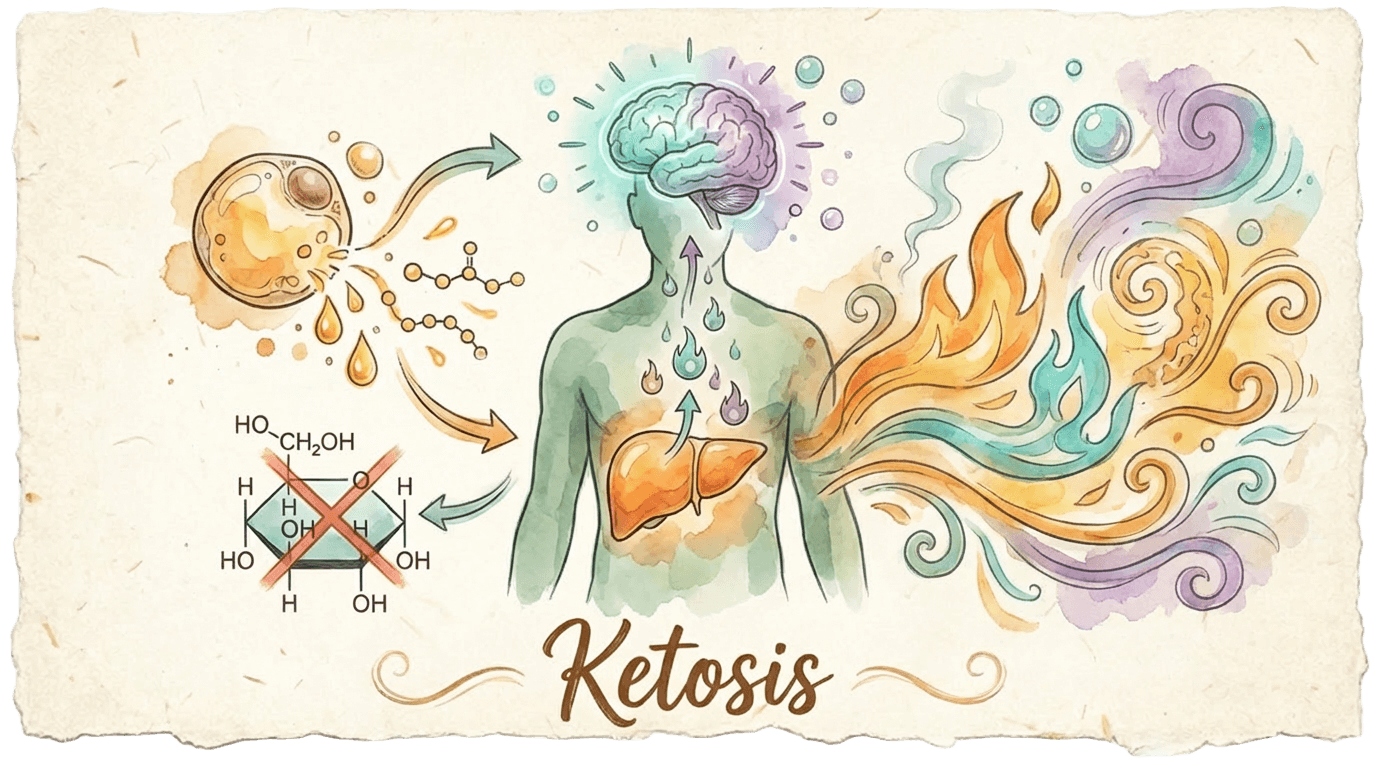
Key Processes During Ketosis
What Are Ketone Bodies?
Ketone bodies are small, water-soluble molecules produced by the liver when carbohydrate availability is low. They serve as an alternative fuel source for tissues throughout the body, including the brain.
There are three types of ketone bodies:
- Beta-hydroxybutyrate (BHB): The most abundant ketone in your blood, and the primary ketone used for energy
- Acetoacetate: The first ketone produced, which can convert to BHB or acetone
- Acetone: A breakdown product that's expelled through breath (causing "keto breath")
According to research published in Annual Review of Nutrition, ketone levels typically begin rising after 12-16 hours of fasting, reaching 1-2 mM after 2 days and potentially 6-8 mM with prolonged starvation.
Beta-Hydroxybutyrate (BHB): More Than Just Fuel
Beta-hydroxybutyrate is not just an energy source-it's also a signaling molecule that can affect gene expression, metabolism, and cellular function.
Research has identified several mechanisms through which BHB influences health:
- HDAC inhibition: BHB can inhibit histone deacetylases, affecting gene expression related to oxidative stress and longevity
- Anti-inflammatory signaling: BHB activates the HCAR2 receptor, which may reduce inflammation
- Metabolic regulation: BHB influences pathways involved in lipid metabolism and energy homeostasis
A 2024 study in Cell Chemical Biology found that BHB can act as a "chaperone" for misfolded proteins, potentially helping clear molecular waste:
Ketone bodies are janitors of damaged proteins, chaperoning away molecular waste so organisms can operate at peak molecular fitness.
Ketogenesis: How Your Liver Makes Ketones
Ketogenesis is the biochemical process by which the liver produces ketone bodies from fatty acids. This process occurs in the mitochondria of liver cells.
Here's a simplified overview of the process:
- Fat breakdown: Triglycerides in fat cells are broken down into fatty acids and glycerol
- Beta-oxidation: Fatty acids are transported to the liver and broken down into acetyl-CoA
- Ketone synthesis: When acetyl-CoA accumulates faster than it can be used, it's converted to ketone bodies
- Distribution: Ketones are released into the bloodstream and transported to tissues for energy
The brain is particularly important here-while it cannot use fatty acids directly, it can use ketones for up to 70% of its energy needs during extended fasting, significantly reducing the need for glucose.
Appetite Suppression in Ketosis
Many people report reduced hunger during ketosis, which is one reason fasting can feel easier after the initial 16-24 hours. Several mechanisms may explain this:
- Stable blood sugar: Without glucose fluctuations, hunger signals are more consistent
- Ketone effects: BHB may directly influence appetite-regulating hormones in the brain
- Ghrelin reduction: The "hunger hormone" tends to decrease after the initial fasting period
- Steady energy: Fat is a more stable fuel source than glucose, reducing energy dips
This natural appetite suppression is why many people find 24+ hour fasts more manageable than expected once they adapt to fasting.
Growth Hormone Peak
Growth hormone levels continue to rise during the ketosis zone. According to research published in the Journal of Clinical Investigation, growth hormone production can increase up to 5-fold after 48 hours of fasting.
This increase in growth hormone serves important functions:
- Muscle preservation: GH helps maintain lean muscle mass during fasting
- Fat mobilization: GH promotes continued breakdown of stored fat
- Tissue repair: GH supports cellular repair processes
- Metabolic rate: GH helps maintain metabolic rate during calorie restriction
The simultaneous rise in growth hormone and ketones creates a metabolic state that may help preserve muscle while promoting fat burning.
Anti-Inflammatory Effects: A Complex Picture
Research suggests that ketosis may have anti-inflammatory properties through several mechanisms:
- NLRP3 inhibition: BHB may inhibit the NLRP3 inflammasome, a key driver of inflammatory responses
- Reduced oxidative stress: Ketones may help reduce markers of oxidative stress
- Gene expression changes: Ketosis affects the expression of genes involved in inflammation
However, the picture is more nuanced than earlier research suggested. A 2025 scoping review found that while some inflammatory markers may decrease during fasting, C-reactive protein (CRP) - a key marker of systemic inflammation - can actually increase during prolonged fasting periods. This suggests that the anti-inflammatory effects of fasting may be selective rather than universal, and may depend on fasting duration and individual factors.
Intermittent fasting (16-24 hours) appears to have a more favourable inflammatory profile than prolonged fasting. More research is needed to fully understand which inflammatory pathways are affected and under what conditions.
Measuring Ketosis
If you're curious whether you've entered ketosis, there are several ways to measure ketone levels:
- Blood ketone meters: Most accurate, measuring BHB directly (optimal range: 0.5-3.0 mM)
- Breath analyzers: Measure acetone; convenient but less precise
- Urine strips: Measure acetoacetate; less accurate as you become keto-adapted
Physiological ketosis (from fasting or a ketogenic diet) typically produces blood ketone levels of 0.5-3.0 mM. This is safe and distinct from diabetic ketoacidosis, which involves much higher levels (>10 mM) and dangerously low pH.
Individual Variation
The timing of ketosis onset varies significantly between individuals. Research shows ketosis can begin anywhere from 12 to 28 hours depending on:
- Prior diet: Low-carb dieters may enter ketosis faster
- Activity level: Exercise depletes glycogen, accelerating ketosis
- Last meal composition: High-carb meals create larger glycogen stores to deplete
- Metabolic adaptation: Experienced fasters may transition faster
- Individual metabolism: Genetics and metabolic health play a role
Additional Resources
Scientific sources referenced in this article:
- Physiology, Ketogenesis - StatPearls (NCBI)
- Beta-Hydroxybutyrate as signaling metabolite - PMC
- BHB anti-inflammatory effects - Cell Chemical Biology
- Fasting enhances growth hormone secretion - Journal of Clinical Investigation
- The effects of popular diets on ketone bodies - BMC Medicine
- Ketosis onset timing variations - PMC
- Intermittent Fasting for Remission - Diabetes UK
Recent Updates
Changes made during our February 2026 content review:
- Revised anti-inflammatory effects section to reflect 2025 scoping review findings showing CRP can increase during prolonged fasting
- Reframed "Potential Anti-Inflammatory Effects" as "A Complex Picture" to better reflect current evidence
Track your journey to ketosis
Private • No account • Works offline
Watch your progress through the fasting zones in real-time. See exactly when you enter the ketosis zone and how long until you reach deep ketosis.
Tip: Most people enter ketosis between 16-24 hours.
This content is educational and based on our interpretation of published research. See our Educational Content Disclaimer. · Last updated February 2026